Reflective Essay on the Super Bowl 2026 Halftime Show (Part 2)
The piragua stand was one of the most endearing and culturally rich symbols of the Super Bowl LX halftime show, and it said a great deal without words. The piragua is the memory of our childhood. In Puerto Rico, a piragua is not just shaved ice with syrup: it is the street, the heat, childhood, and the neighborhood. Piragua carts appear in town squares, on beaches, at patron saint festivals, and on street corners.

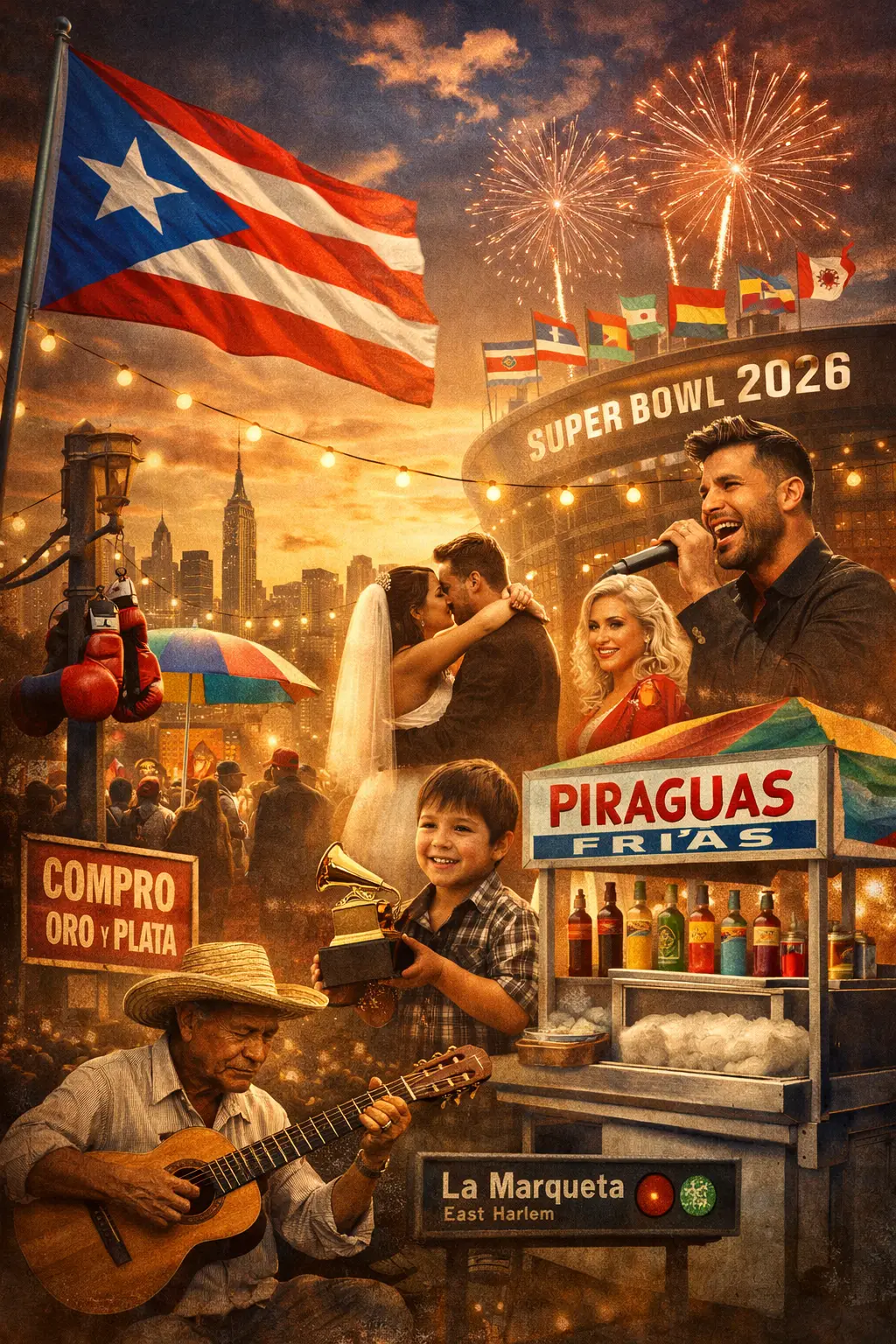
I personally remember the piragua cart when I used to leave church on Sundays. My father would give me five cents to put into the collection. When I came out of church, the piragüero would be outside waiting for customers. I was not one of his customers, but one spring day, I became a devoted admirer of this well-known character in the eyes of children.
I want to share one of my experiences with the piragüero from my neighborhood. As I left church, I would approach his cart and look carefully, trying to learn the names of each flavor, even though I could not afford to buy one. I was content just watching other children enjoying their piraguas, always thinking that the day would come when I would have money for my own.
One Sunday, I was especially attentive, waiting to hear the name of a flavor I did not recognize, when I heard a familiar voice. I looked around but did not see the person. It was the voice of a young girl. I searched through the crowd, but I did not recognize anyone. A few seconds later, the voice was heard again. I looked quickly and then realized it was my sister, who was buying a piragua.
I could not believe it. How could my sister have money for a piragua when I did not? I kept watching her, and then I remembered: of course—she had not put her money into the church collection. My sister received her piragua and walked away. I approached her, and she looked at me and whispered:
“I’ll give you a little, but don’t say anything at home.”
She shared her piragua with me, and the problem was solved. The following Sunday, during Mass, it was time for the collection, and the usher stopped in front of me. I did not look at him, hoping he would get tired of waiting, but he remained there. Finally, he looked at me with a gesture of disapproval and moved on. When I left the church that day, I also had money for my piragua.
For me, and for many others, that moment represents one of the first happy memories of childhood. Bringing that piragua cart onto the Super Bowl stage was like bringing my Puerto Rican childhood to the center of the world.
Villa Tacos: The Neighborhood as Shared Identity
Villa Tacos immediately makes us think of a very Mexican food that has gradually spread to other countries in the Americas, including the United States. At first glance, it seems ordinary, almost decorative. But in the context of the halftime show, it is not.
“Villa” is the keyword. It is not used at random. In the Latino world, it evokes the neighborhood, community, popular space, and a lived-in place rather than a tourist destination. It is not “Gourmet Tacos,” nor is it “Luxury Tacos.” It is the people’s food.
Villa Tacos represents the Latino neighborhood, not a specific country. Why tacos in a show about Puerto Rico? That is precisely the point. Tacos are not Puerto Rican, and that is the message. The taco stand symbolizes shared Latin identity, the migrant experience, and cultural blending in the United States. It reflects neighborhoods where Mexicans, Puerto Ricans, Dominicans, and Central Americans live side by side. It is not about a single identity, but about a shared experience.
Many stands like this one exist because the formal system excludes people. Work is reinvented, and families are sustained. The taco here is not “exotic”; it is dignified labor.
The Boxers: Struggle and Respect
The two boxers represent one of the most followed and practiced sports in Puerto Rico and Mexico. These two countries have long shared an intense competitive history in boxing. The boxers are not there simply as a sporting spectacle; they are there as a metaphor.
Even without names being announced, the cultural code is immediate: Puerto Rico vs. Mexico is one of the deepest and most respected rivalries in the boxing world. But rivalry does not mean hostility.
What does this rivalry represent? National pride. Both people come from working-class backgrounds, share histories of colonization and inequality, and used boxing as a path to social mobility. The ring symbolizes a clear idea: here, the fight is for dignity, not just money.
The boxers signify that Latino identity is forged in struggle but sustained through respect.
“We Buy Gold and Silver”: Surviving by Selling Memories
The stand that reads “We Buy Gold and Silver” represents economic crisis and necessity. In Puerto Rico and in many Latino communities, these signs appear most frequently when there is unemployment, debt, emergencies, and when money is simply not enough. The implied message is harsh but real: when there is no other option, people sell what they value most.
This is not luxury commerce; it is an economy of survival. Sometimes, even cherished memories must be sold and kept only in our minds to keep going.
I myself had to part with many of my wife’s memories and my own at one of these places. I will always remember the difficult years of our marriage—severe financial hardship and, as my grandmother used to say, “there are many mouths to feed.” After trying unsuccessfully to have children, we had resigned ourselves to that reality. Then, suddenly, my wife became pregnant, and later we learned she was expecting twins. Everything was joy.
We went through many struggles while waiting for their arrival, but they were finally born. When the twins began to walk, we learned that one of them had a problem with his legs and needed orthopedic braces to straighten them. We lived paycheck to paycheck and did not have the money to buy them.
At that time, there were many gold-buying establishments in Puerto Rico. Without hesitation, my spouse removed a solid gold ring she owned and handed it to me so I could sell it. I went out looking for one of those places and, almost by magic, found one that caught my attention. I went in, and the owner greeted me kindly. I showed him the ring, and after examining it, he said:
“I collect these kinds of rings. I can give you $115.00 for it.”
I was surprised, but I accepted because it was exactly the amount we needed to buy the braces for our baby. $115.00 seems like a small amount today, but in 1981, it was precisely what we needed. I do not know whether it was a coincidence or the good star that has guided me throughout my life in difficult moments.
Placing a “We Buy Gold and Silver” sign during the halftime show was a visual shock: extreme wealth versus extreme need, spectacle versus everyday reality. It does not shout—it whispers, and that is why it hurts more.
The Ring, the Wedding, and Dignity That Cannot Be Sold
The ring that the gold buyer hands to Bad Bunny is one of the most symbolically charged gestures of the entire Super Bowl LX halftime show. It is not a simple stage accessory; it represents dignity that cannot be sold.
The buyer purchases everything—except something essential. By returning the ring, the gesture suggests that there are things that should never be sold, even in times of need. The ring represents identity, dignity, and personal worth. Bad Bunny does not sell it; he receives it and preserves it for an occasion that symbolizes the happiness of two people in love.
That ring condenses many stories: those of people who had to sell theirs and those who resisted. By receiving it, the artist becomes a custodian of collective memory—a witness, a symbolic guardian, and a spokesperson. It is as if the message were: I carry with me what many others had to give up.
The wedding was one of the deepest and most emotional symbols of the halftime show. It was not a folkloric decoration; it was the human heart of the spectacle. In times of economic hardship, getting married is not a luxury—it is a brave decision. The wedding represents choosing love when there are no certainties, betting on the future without guarantees, and saying “we go on” despite everything.
In Puerto Rican and Caribbean culture, a wedding does not unite only two people; it unites families, neighbors, and reaffirms community. That is why it appears surrounded by everyday scenes of work, street vendors, and construction. The wedding is the center that gives meaning to everything else. It is pause, promise, and meaningful silence.
“Mónaco,” the Violins, and Cultural Affirmation
During the performance of the song “Mónaco,” a group of violinists played live and was prominently featured on stage. This was not a permanent symphony orchestra but rather a group of professional musicians assembled specifically for this production, as is common at large-scale events like the Super Bowl. Xóchitl Martínez, originally from Monterrey, was one of the violinists who accompanied Bad Bunny during the halftime show. The ensemble was conducted by Maestro Giancarlo Guerrero, a multiple Grammy Award–winning conductor, artistic director of the Grant Park Music Festival in Chicago, and music director of the Sarasota Orchestra.
The message conveyed by Bad Bunny during “Mónaco,” accompanied by the orchestra, was profound. “Mónaco” evokes luxury, elites, exclusivity, and European economic power. By performing the song with a classical orchestra—a historic symbol of prestige and high culture—Bad Bunny sends a clear message: we can enter these spaces without ceasing to be who we are.
He is not imitating the elite; he is redefining it from a Latino and Caribbean perspective. Reggaeton and urban music have often been labeled as “simple” or “lesser.” The violins make a powerful statement: our music can also be complex, elegant, and universal. This is not cultural whitening; it is expansion.
The message is twofold: yes, we have come far, but we have not forgotten where we come from. True power does not lie in money, but in an identity that endures. Without slogans or explicit speeches, this moment communicates cultural dignity, artistic legitimacy, and Latino presence on the most-watched stage in the world.
We are here. And we are not leaving.
These symbols didn’t appear randomly.
Each halftime scene was a piece of a larger narrative about dignity, memory, and belonging. In the next part, I’ll continue exploring the show’s final gestures, where identity, history, and hope converge into a single message.
To be continued… 3/12/2016.
Discover more from Stories, Flowers and Books
Subscribe to get the latest posts sent to your email.
No responses yet