Reflective Essay on the Super Bowl 2026 Halftime Show (Part 3)
The appearance of Lady Gaga at the wedding during the Super Bowl LX halftime show was deliberate and highly symbolic. It was not a gratuitous cameo; it functioned as a cultural bridge and an artistic validation within the narrative Bad Bunny was constructing. Lady Gaga represents global pop, the Anglo music industry, and the dominant cultural canon. Placing her at the wedding is equivalent to a symbolic blessing: Latin culture does not ask for permission—it is recognized as an equal.

The wedding does not unite only two people; it unites worlds: the Latino and the Anglo, the popular and the “prestigious,” the communal and the global. Gaga embodies that union: she does not erase identities; she connects them. Both Gaga and Bad Bunny have challenged norms, expanded the boundaries of pop, and defended authenticity. Her presence communicates creative solidarity; those who open paths recognize one another.
Lady Gaga does not steal the spotlight. She reinforces the meaning. The center is the community, the center is the wedding, the center is the story. Her role is to accompany, not to overshadow. Her presence at the wedding signifies cultural recognition and validation, unity without assimilation, an artistic alliance between equals, and the passage from the local to the universal without losing the soul. It is a silent yet powerful gesture: our culture marries the world without ceasing to be itself.
New York: La Marqueta and the Diaspora
La Marqueta is a historic market in East Harlem, known as El Barrio. It does not represent the New York of Wall Street, skyscrapers, or luxury. It represents the New York of immigrants, Latinos, workers, and invisible communities.
By including La Marqueta in the halftime show, Bad Bunny makes a clear statement: this is also New York. For decades, La Marqueta has been a Puerto Rican gathering place, a space for food, music, and culture, and a refuge for those who arrived seeking a better future. For Puerto Ricans, it symbolizes diaspora, resistance, and belonging. It is not tourism; it is home away from the island.
Like the piragua stand or the nail salon, La Marqueta represents small merchants, daily labor, and survival with dignity. It is the economy that sustains lives, not headlines. For many years, popular culture portrayed a New York without Latinos, without Caribbeans, and without humble neighborhoods. Bad Bunny corrects that narrative on the most visible stage in the world and declares out loud: without us, this city does not exist.
The sign for La Marqueta symbolizes Latino and Puerto Rican New York, a city built by immigrants, the dignity of small labor, and the memory that travels with those who migrate. It is a small gesture with an enormous message: history is also written from El Barrio.
The Grammy: Returning Success to the Community
The gesture of handing one of his Grammy Awards to a child in his home, alongside his parents, was one of the most human and powerful messages of the Super Bowl LX halftime show. It was deeply symbolic. By placing the Grammy in the hands of a child, Bad Bunny is saying: this achievement does not belong only to me. It is a symbolic return of success to the community and, especially, to the next generation.
By removing the award from the stage and placing it in a modest living room, the message is clear: excellence does not live only on red carpets. The award is designed to be humanized. The child is not in a stadium or at a gala; he is at home, with his parents. That matters, because it communicates that you do not need privilege to dream, that your origin does not limit your future, and that someone like you can reach that level.
It is an act of quiet empowerment. The presence of the parents underscores another essential value: talent does not grow alone; family support sustains dreams. Success is presented as a collective project, not as an individual feat. It is a sentence without words in which Bad Bunny says: if I could do it, so can you.
The Jíbaro, the Cuatro, and Hawaii as a Warning:
The jíbaro represents the Puerto Rican of the land—the humble, hardworking, and resilient farmer. It is a profound symbol of national identity, cultural roots, dignity in the face of poverty, and resistance to colonization.
The Puerto Rican cuatro, with its melancholic yet proud sound, is associated with nostalgia and historical memory. It is the voice of the people who do not appear in power or in headlines. The implicit message is clear: before fame, before global spectacle, before pop, Puerto Rico is this—its simple people, its history, its roots. It is a way of saying: this is where the story begins.
Here the key turn occurs. Ricky Martin does not appear merely as a pop star; he appears as a Puerto Rican with historical consciousness. The song “Lo que le pasó a Hawái” functions as a powerful political metaphor.
What happened to Hawaii? It was an independent kingdom. The United States intervened. It was annexed. It lost its true sovereignty. Today it is a state with a diluted identity and a history that has largely been erased.
Why sing it here? Because the question is not about Hawaii. The question is: is this what we want for Puerto Rico? Cultural disappearance under the banner of progress?
The order of the symbols matters: the jíbaro is the root; the cuatro is the singing memory; Ricky Martin is the voice the world recognizes; Hawaii is the mirror of a possible future. It is a message in two movements: first, look at who we are; then, look at what could happen to us. Without saying it explicitly, the show asserts that a people without memory is easy to absorb, but a people who remembers resists.
That this message was delivered in Spanish, during the Super Bowl, before millions of viewers, constitutes a cultural and political act of great intensity.
The Power Poles: Trauma and Resistance
In Puerto Rico, power poles are not merely urban objects. They have become symbols of collective trauma. They represent chronic blackouts—especially after Hurricane Maria—government abandonment, fragile infrastructure, and a daily life constantly interrupted.
Above all, they evoke the experience after Maria, when people lived for months without electricity, when hospitals, schools, and homes were left in darkness, and when the nighttime silence was real and frightening.
The workers climbing those poles symbolize the Puerto Rican laborer: the one who risks his life, the one who “makes it work” when the state fails, the one who holds the country up from below. Many of them worked without resources, without sufficient support, and with improvised equipment, while the world had already moved on to the next headline.
Puerto Rico does not collapse; it is lifted by its workers.
This moment points—without naming names—to the failure of the electric authority, to poorly managed privatization, to structural dependency, and to broken promises. The show does not point fingers; it shows consequences.
The Final Image: Identity Without Surrender
When Bad Bunny appears alone, holding the Puerto Rican flag at the front, the message is unmistakable: he presents himself first as Puerto Rican. Not as a global artist, not as an American celebrity, not as a “Latino product.” It is an affirmation of identity before any other loyalty. Puerto Rico stands at the front—undiluted, unmixed.
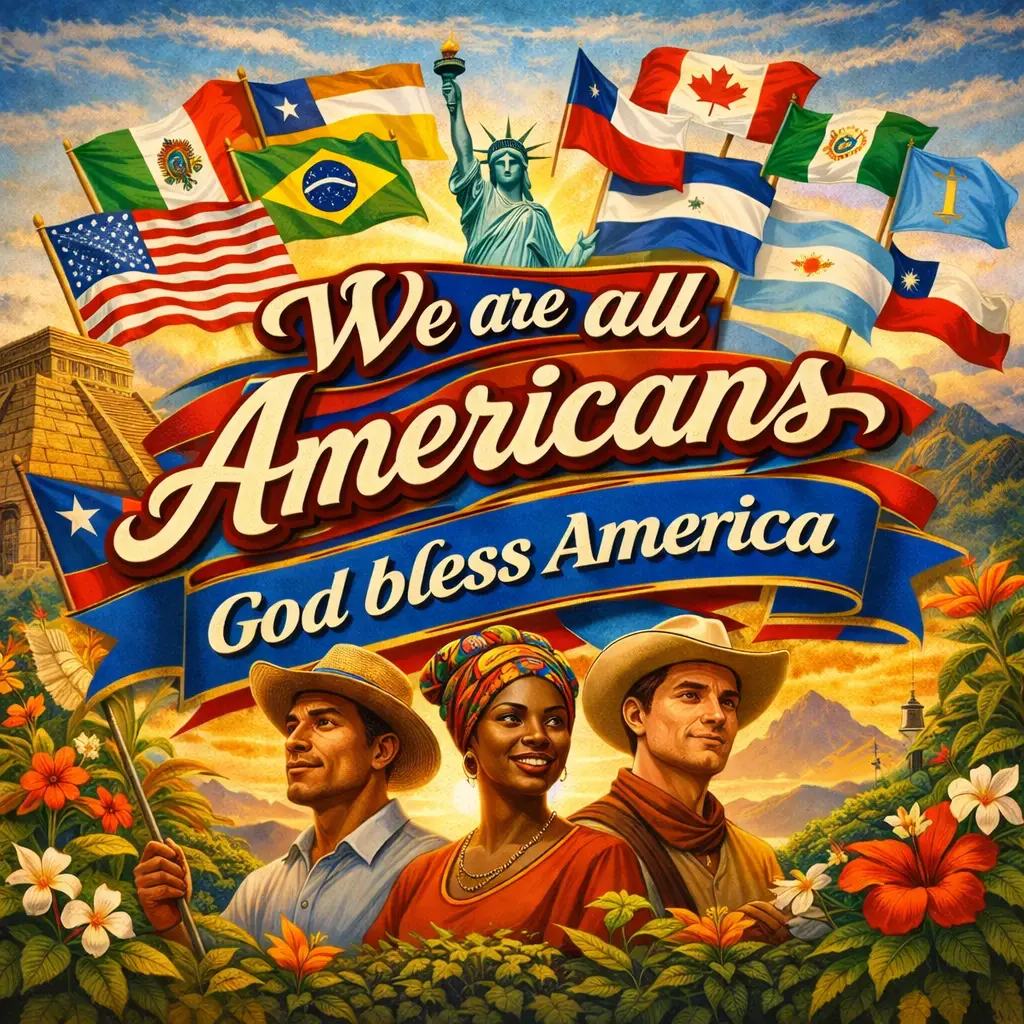
Behind him appear all the flags of the Americas, including those of the United States and Canada. This is not “America first.” It is America as a continent, not as an empire. Puerto Rico does not disappear among the flags; it leads the image while acknowledging that it belongs to a larger space. The message is one of continental belonging, hemispheric solidarity, and identity without submission.
The only phrase spoken in English—“God bless America”—is key. The entire narrative unfolded in Spanish except for that line. Why? Because the phrase is not cultural; it is institutional. It is not merely a prayer; it is a political slogan, a presidential closing phrase, the language of power. Saying it only once communicates: I hear you, I respect you, but I will not change my language or my message. Bad Bunny does not translate his art into English; he speaks English only to close the symbolic pact.
By invoking “God,” he does not call upon a specific religion, but rather a shared value. It is a bridge that crosses borders, languages, and flags. It is a blessing, not a surrender.
Conclusion: An Act of Cultural Maturity
This halftime show did not shout independence, nor did it beg for inclusion. It did not provoke with anger. It did something more difficult and more mature: it affirmed itself without asking for permission.
The Super Bowl 2026 halftime show was far more than a musical performance. It was a cultural essay in motion—a carefully constructed narrative that used symbols, silences, language, and contrast to tell the contemporary story of Puerto Rico on the most visible entertainment stage in the United States.
It was not gratuitous provocation nor explicit propaganda. It was a conscious affirmation: a people who name themselves, who remember their past, who show their wounds, and who place themselves in the world without asking permission.
On the largest media stage in the United States, Puerto Rico spoke in its own language, with its own symbols and its everyday truth—not to divide, but to exist fully.
Like all good cultural essays, it did not close with definitive answers, but with one essential certainty:
A people who name themselves do not disappear.
That was the true message of the Super Bowl 2026 halftime show.
Congratulations, Benito—son of Puerto Rico.
Editorial Closing
Throughout these three installments, I have attempted to look at the Super Bowl 2026 halftime show not as a fleeting spectacle, but as a carefully constructed cultural narrative. Each image, each gesture, and each silence formed part of a broader story about identity, memory, and dignity.
This was not a message of confrontation or division. Rather, it was an act of calm affirmation: a people recognizing themselves, remembering where they come from, and presenting themselves to the world without disguises or forced translations. On the most widely viewed stage of global entertainment, Puerto Rico spoke in its own language, showed its daily reality, and shared its history without asking for permission.
This halftime show reminded us that culture is sustained not only through grand speeches, but through small, everyday acts—through work, community, family, and memory passed from one generation to the next. It reminded us that dignity is not negotiable, that identity is not diluted, and that hope, even in difficult times, remains an act of resistance.
As readers, we may or may not agree with this interpretation. But as a people, something endures: when a culture names itself, it remains alive. That, in essence, was the legacy of the Super Bowl 2026 halftime show.
Discover more from Stories, Flowers and Books
Subscribe to get the latest posts sent to your email.
No responses yet