Blue, Blue, Blue
When a spectacle on the scale of the Super Bowl repeats the same key color across wardrobe, staging, and national symbols, we are not facing a casual aesthetic choice, but a conscious aesthetic and symbolic decision.
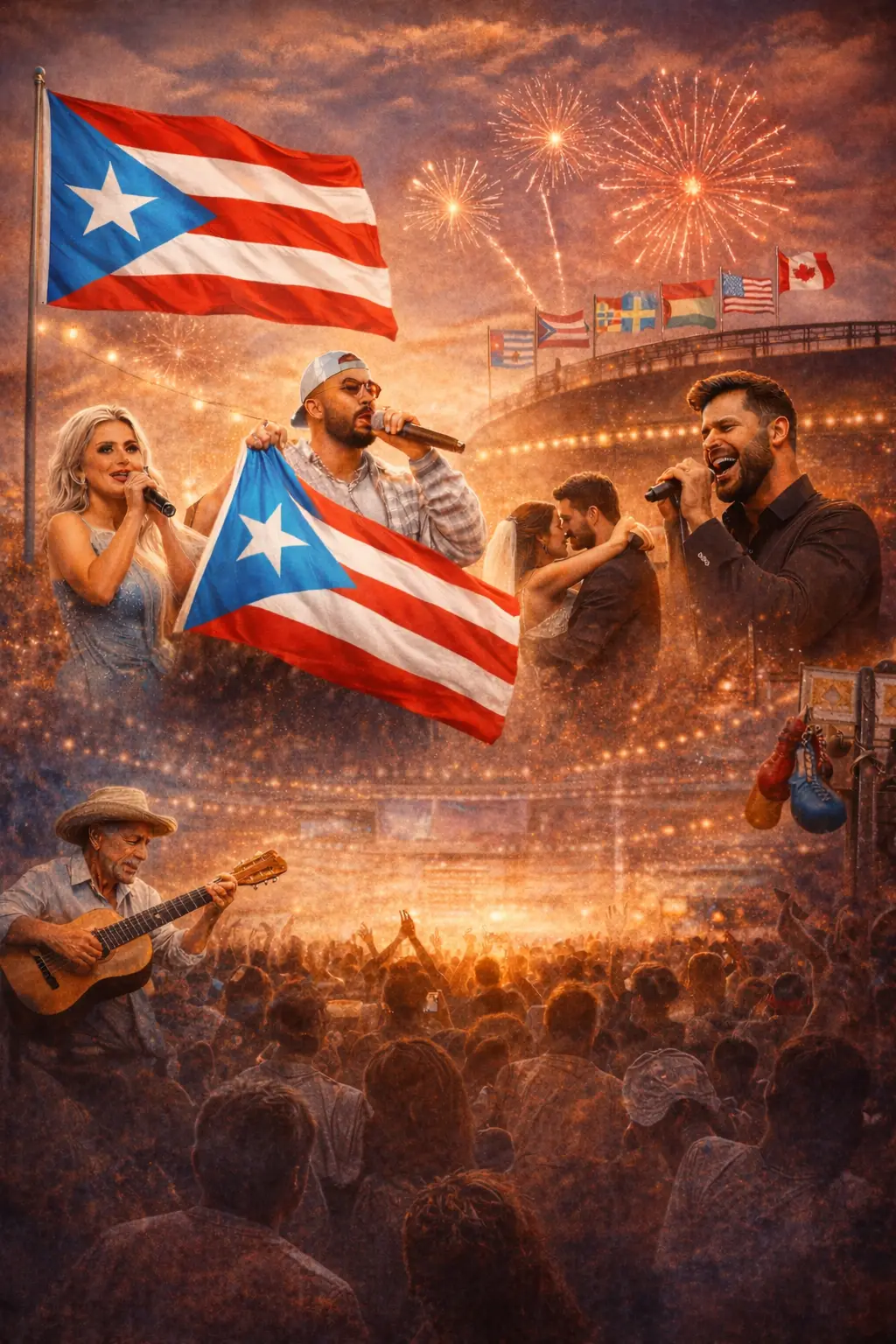
Let’s break it down.
Sky Blue: an intentional visual thread
Light blue appears in three central and distinct elements of the show:
- Lady Gaga’s dress
- The musicians’ shirts
- The light-blue triangle of the Puerto Rican flag carried by Bad Bunny
When a color connects people, music, and a national symbol, a unified visual language is being constructed.
What does light blue represent in the Puerto Rican flag?
Traditionally, the blue of the triangle in the flag has varied depending on the historical period and political context:
- Dark blue is usually associated with official and institutional versions.
- Light blue (sky blue) has become, over time, a cultural and popular symbol associated with:
- The sky,
- The sea,
- Hope,
- An identity that is not military or authoritarian, but human and open.
In contemporary Puerto Rican culture, light blue is perceived as the blue of the people, not of power.
Lady Gaga and the musicians: neutrality that unites:
Lady Gaga wearing sky blue is not merely an elegant aesthetic decision:
- Light blue is a non-aggressive, non-confrontational color.
- It symbolizes calm, respect, and openness.
- It places her as a bridge, not as a dominant figure.
That the musicians wear the same tone reinforces the ideas of:
- Harmony,
- Balance,
- Narrative unity.
There is no chromatic hierarchy: everyone occupies the same symbolic plane.
Bad Bunny and the flag: serene identity, not combative.
When Bad Bunny holds the flag with the light-blue triangle, the message is very clear:
- It is not a gesture of confrontation.
- It is not a shout.
- It is a calm affirmation of identity.
Light blue softens the symbol without weakening it. It says:
“Here we are, without aggression, without asking permission, without renouncing who we are.”
The combined message of color
By repeating sky blue in these three elements, the show communicates something very precise:
- Puerto Rico
- Music
- Cultural dialogue
…inhabit the same emotional space.
There is no clash.
There is no imposition.
There is continuity.
Conclusion
This is no coincidence.
Sky blue functions as:
- A symbol of hope without naïveté.
- Identity without stridency.
- Unity without assimilation.
It is the color of a message that does not need to shout to be firm.
The original blue vs. “navy” blue
Historically, light blue was the original color of the triangle in the Puerto Rican flag, associated with the sky, with ideals, and with inspiration drawn from the Cuban flag (which also used light blue in its original versions).
Over time—and especially after the consolidation of the political relationship with the United States—the blue darkened into navy blue, aligning chromatically with the U.S. flag, military codes, and institutional visual language. This change was not innocent; national colors also communicate power, belonging, and hierarchy.
What does returning to light blue at the Super Bowl imply?
When Bad Bunny appears with the flag whose triangle is sky blue, the gesture can be read on multiple levels, all coherent with the rest of the show:
- Historical recovery:
No new symbol is invented; an older one is recovered. It is a visual return to an identity that predates institutional standardization. - Separating culture from power:
Light blue distances itself from military, imperial, and administrative language. It moves closer to cultural, human, and popular language. It does not deny political reality, but it does not define itself by it. - Aesthetic coherence with the message:
The same light blue appears in Lady Gaga’s dress, in the musicians’ clothing, and in the general visual atmosphere. The message is not delivered through slogans, but through chromatic continuity: culture, music, and identity share the same emotional color.
Very important: what light blue does not do
❌ It does not declare independence.
❌ It does not deny the relationship with the United States.
❌ It does not provoke confrontation.
What it does is more subtle—and more mature:
It says “this is who we are” without saying “this is what we want you to be.”
Conclusion
The use of light blue connects directly with history before the navy blue. It fits perfectly within a show that speaks of memory, recovers symbols without shouting, and affirms identity through culture, not decree. It is a historical, aesthetic, and narrative decision—not a coincidence.
Color as silent political language:
At the Super Bowl 2026 halftime show, the most powerful message was not expressed through words, slogans, or explicit declarations; it was expressed through color. The show understood something fundamental: on a stage where every word is monitored, debated, and politicized, color can communicate with greater depth, ambiguity, and elegance.
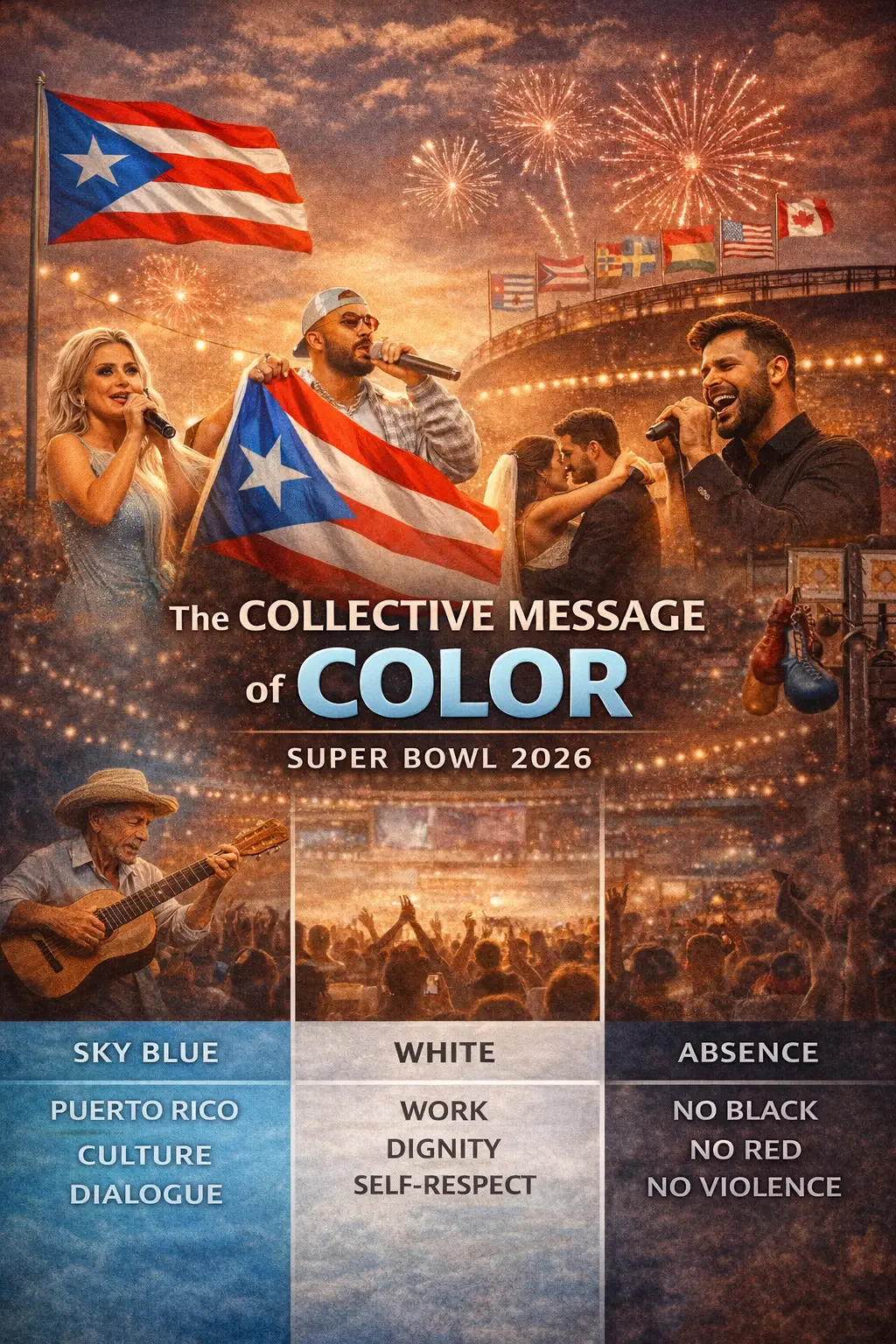
Color functions as a language that precedes discourse. It does not argue; it suggests. It does not confront; it guides. It does not impose; it invites interpretation. In this halftime show, the deliberate use of light blue, dominant white, and the absence of dark or aggressive tones built a silent political narrative—yet one that was extremely clear to those who knew how to read it.
Light blue, recurring in wardrobe, staging, and the Puerto Rican flag held by Bad Bunny, does not operate as a symbol of institutional power. On the contrary, it distances itself from navy blue, associated with the military, the imperial, and the administrative. Sky blue evokes the sea, the sky, openness, and humanity. It is a color that does not dominate, but accompanies. Its message is not “to command,” but “to exist.”
White, for its part, appears as a constant background: in the clothing of the jíbaros, in Bad Bunny, in Ricky Martin, and at the wedding. White does not shout identity; it cleans it. Instead of marking ideology, it marks dignity. It is the color of honest labor, of cleanliness within poverty, of self-respect.
Politically speaking, white here says: we are not noise; we are presence.
Equally important is what does not appear. The show avoids dominant black, aggressive red, and violent contrasts. There is no palette of confrontation. This absence is key. The narrative is not built from rage or frontal opposition, but from serene affirmation. It is a politics of non-collision, of quiet permanence.
Thus, color replaces explicit discourse. Where others would have placed slogans, chromatic coherence was placed; where others would have shouted, here harmony prevailed. The result is a political message that is harder to attack, because it cannot easily be quoted or taken out of context. It does not say “this is what we demand”; it says “this is who we are.”
Using color as a silent language allows something fundamental: speaking without translating oneself. The show does not adapt its message to make it digestible; it keeps it intact and trusts that those who want to understand it will. Color does not ask permission. It does not negotiate; it simply exists.
In that sense, the halftime show was not apolitical. It was perhaps more political than many open speeches. It chose a more complex and more mature path: identity expressed without confrontation, memory shown without accusation, belonging affirmed without submission. Color here does not decorate; it governs the narrative. And that is precisely its greatest power.
A wise decision.
Discover more from Stories, Flowers and Books
Subscribe to get the latest posts sent to your email.
No responses yet