Reflective Essay on the Super Bowl 2026 Halftime Show (Part 1)
After several weeks, people are still talking about the Super Bowl halftime show. I have heard many positive and favorable opinions about this event, as well as others that are not so favorable. I do not usually like to write about controversial topics, especially when politics is involved. My message has always been one of love, unity, and hope for a better future.
However, the Super Bowl 2026 halftime show has generated so much discussion that I feel it is worth sharing some details that, in my opinion, deserve reflection. I want to do so without political feelings or favoritism. Although I have lived in the United States of America for more than thirty years, I am Puerto Rican. I feel a deep love for the country in which I have lived most of my adult life. It is a country with many good, open-minded people, but I dare to write about this topic because I am Puerto Rican.
I believe that most people who speak unfavorably about Bad Bunny’s performance do so because they did not understand the message the artist was trying to convey to the audience, or simply for other reasons that, although I may suspect them, I prefer not to mention. I leave it to you to reflect on the reason or reasons. The most common opinion I have heard is that they “didn’t understand anything,” that they did not understand the message, and therefore did not like it.
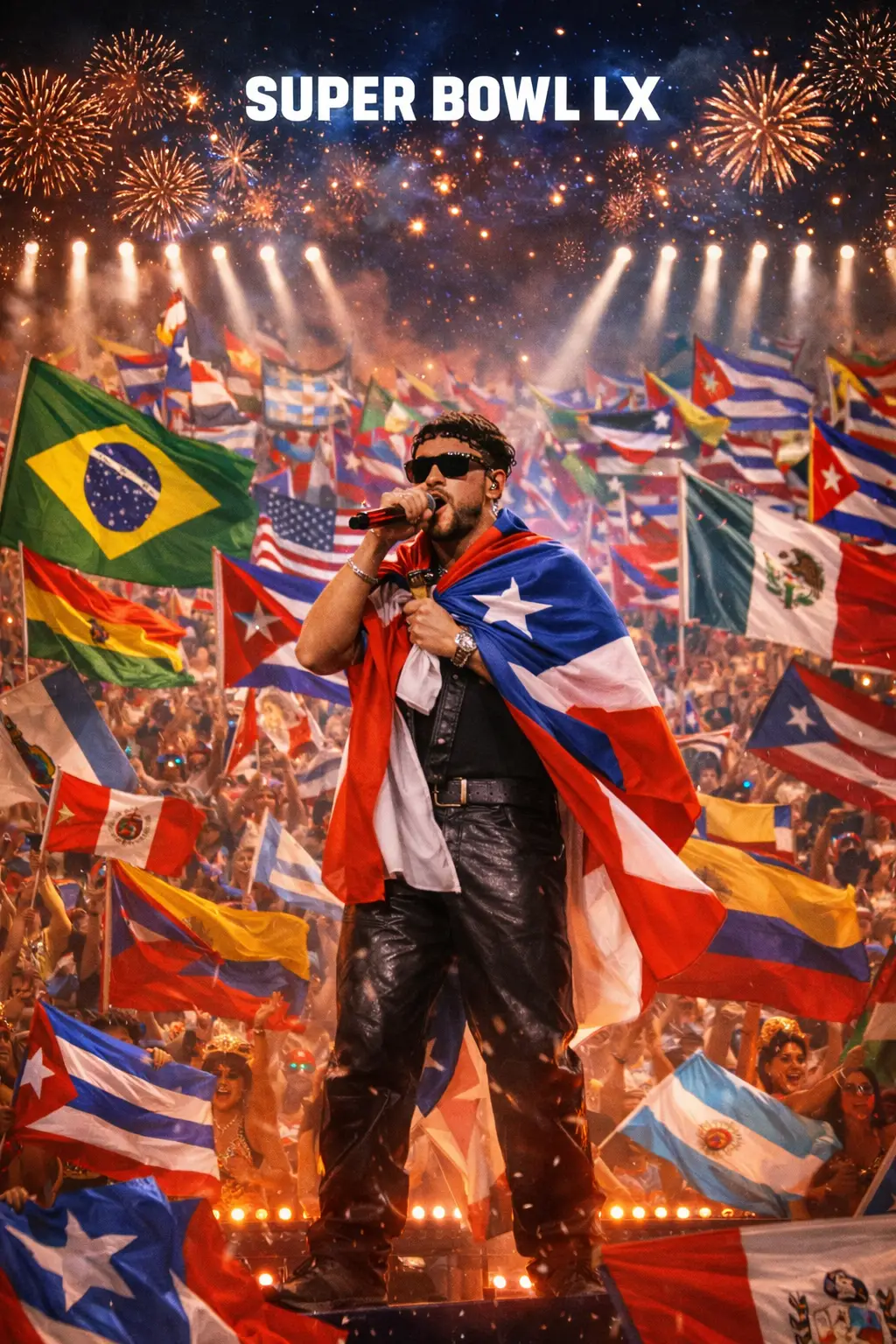
Especially for those people, I would like to analyze a few points that I believe are important to consider. First, I want to say that all public opinions are valid. When they are negative, it is often because people do not understand what they are seeing; other people say they did not like it. A few opinions may be influenced by discrimination based on skin color or language, but I leave that for each reader to judge. I respect all opinions, and I generally read as many as I can find.
In my opinion, one must observe and analyze before forming an opinion, because that opinion may change once the event is better understood.
The Sugarcane Fields: Beginning with History
Those who do not know Puerto Rico’s history cannot fully understand why the halftime show began with sugarcane fields and farmers cutting sugarcane.
Sugarcane is not just any crop in Puerto Rico. It is a historical symbol that represents the colonial economy, the hard labor of the peasantry, the exploitation of both land and body, and the origins of deep social inequalities. For decades, jíbaros worked in the sugarcane fields under the sun, earning minimal wages and without labor protections, producing wealth that never remained in their hands. To begin the halftime show, it is to begin at a historical wound, not at success.
The white, long-sleeved shirt is a key and culturally precise detail. Why white? First, because Puerto Rican jíbaros traditionally wore white shirts. White softens the intense tropical heat and also symbolizes humility and dignity. It is not luxury; it is cleanliness within poverty. A jíbaro could be poor, but he was never careless. In rural Puerto Rican culture, there was a saying: you may have nothing, but you go out clean. The white shirt represents self-respect.
Why long sleeves? It is not about aesthetics; it is about survival. Long sleeves protect against the scorching sun, prevent cuts from the sugarcane, reduce insect bites, and lessen irritation from sugarcane fibers. This is real work clothing, not a theatrical costume. It directly connects to the idea of invisible, daily, and uncelebrated labor.
The Jíbaro: A Working Class, Not a Tourist Postcard
The halftime show does something very important: it does not portray the jíbaro as a romantic figure, but as a worker. There are no exaggerated smiles, folkloric dances, or bright postcard colors. Instead, there is effort, silence, repetitive rhythm, and bodies bent toward the earth. This reminds us that Puerto Rico was built on the backs of its people.
Music, Youth, and Cultural Scenes
Music has always been, and will always be, part of Caribbean culture. Drums and dancing at night after work, and on days off, were part of Puerto Rican life. Bad Bunny wanted to give everyone something to remember; that is why he begins with the youth who supported him from the very beginning and continues to do so today. He begins with reggaeton, the musical genre most listened to by young people on the island.
Most of his songs use language that older generations may not like. We also know that both in Spanish and in English, rap and reggaeton have long included sexual content and strong language. In that sense, I do not understand why people complain about Bad Bunny’s lyrics, as this kind of language has been present in U.S. music for many years. It is also important to note that much of the inappropriate language was either censored or not included in his songs during the show. That reggaeton segment was meant as a tribute to young people.
After that, we are presented with cultural and historical scenes from the country.
The Coconut Vendor: A Scene of Memory
As the singer walks through the stage, he encounters different traditional scenes from Spanish-speaking countries, especially Puerto Rico. The first one we see is a coconut vendor.
The earliest and most common use of coconut water in Puerto Rico was, and still is, selling cold coconuts so people can cool off from the Caribbean heat. I always remember that when I started working as a young man, I would see coconut vendors, especially on Friday afternoons. One day, I stopped and ordered one. While the vendor was preparing it, he looked at me and asked:
“Baptized or unbaptized?”
I didn’t know what he meant, so I automatically answered, “Unbaptized.”
He handed it to me right away. I kept thinking about what he had said, and the following Friday, I stopped again for another coconut. When he asked if I wanted it baptized, I quickly said, “Baptized.”
I wanted to know what the baptism was. The coconut vendor stepped aside, looked around, and pulled out a bottle of whiskey he had hidden in his coconut cart. He poured a little into the coconut and handed it to me. It cost $1.75 with the baptism, which at the time I thought was expensive, but at least my curiosity was satisfied.
Dominoes: Community and Everyday Resistance
Next comes one of the traditions of Puerto Rico, the Caribbean, and much of the Americas: the game of dominoes. This game is never missing from family gatherings in Puerto Rico. In Spanish-speaking countries, there are many domino tournaments with prizes and trophies.
In Puerto Rico (and in much of the Caribbean), dominoes represent social life, memory, and everyday resistance. Dominoes are never played alone. They are played in the street, the carport, the corner, the beach, and the neighborhood. They involve conversation, argument, laughter, silence, and glances. They are about being together.
In the context of the Super Bowl, Puerto Rico is not defined as an isolated individual, but as a community. At the domino table, money does not matter. Status does not matter. Titles do not matter. Everyone has tiles. Everyone waits for their turn. It is a powerful metaphor for popular democracy, not institutional democracy.
The Improvised Nail Salon: Invisible Women’s Labor
An improvised nail salon, with women working and serving customers, represented a typical and creative business within many Latino communities, especially in the United States, where beauty salons are spaces of both labor and cultural socialization. This scene was perceived as a recognition of manicurists and their artisanal work, elevating it to a massive stage like the Super Bowl.
What does it represent culturally? Invisible women’s labor. The nail salon symbolizes the work of immigrant women and self-employment when the formal system excludes them—an economy that quietly sustains households. Many women do not appear in statistics or political speeches, yet they hold entire communities together. The halftime show gave them visibility without words.
It also represents body, care, and dignity. Nails are not just aesthetics; they are personal care, identity, and control over one’s body. In contexts of hardship, getting one’s nails done is a way of saying, “I am still a person, even when the environment is harsh.” It is everyday dignity.
The improvised nail salon says this clearly: not all work requires a uniform or a contract, but all work has dignity.
Women Building a Home: A Symbol of Survival
The image of women working in construction during the Super Bowl halftime show is neither literal nor accidental; it is symbolic and points to multiple cultural layers.
A house is a symbol of life, dignity, and the future. In Puerto Rican and Caribbean culture, building a home represents stability, family, belonging, and hope. Many houses—especially in humble neighborhoods—were built little by little, with the help of relatives, neighbors, and very often the silent labor of women. The scene evokes that historical reality: the house not as luxury, but as an act of resistance and survival.
Memories from my own life in a Puerto Rican community come back to me, where neighbors helped one another. I remember my parents’ house, where I lived until I got married. It was built with the effort of neighbors, my father, my friends, and me. When I came home from school in the afternoon, I would change out of my school clothes and help my father mix cement to lay the house’s floor. In the same way, I helped many of my friends build their homes. It was very hard work, rewarded only with a beer when the sun went down, and darkness arrived.
This was just the beginning.
The 2026 Super Bowl halftime show wasn’t just about music and spectacle; it was a narrative of work, memory, and community. In the next part, I’ll continue exploring other symbols that complete this cultural and human story, where personal and collective history intertwine.
To be continued… 3/5/2026.
Discover more from Stories, Flowers and Books
Subscribe to get the latest posts sent to your email.
No responses yet