Melchior looked at Artaban, smiled at him, and then left. Artaban was deeply shaken. He did not know whether to turn back or continue on his way to Bethlehem. Without thinking twice, he spoke to his servant.
Artaban:
Prepare my strongest camel, provisions for a long journey, and enough money. I am going on an extraordinarily long trip.
Artaban resumed his journey toward Bethlehem. When he arrived, there was great commotion. Soldiers were murdering all the children under the age of two. When the soldiers saw him, they detained him for questioning.
Soldier:
Hey! What are you doing here? Where do you come from, and where are you going?
Artaban was frightened. He did not know what to say. The soldier pressed him again.
Soldier:
Answer me! Are you one of those who worship the so-called Messiah?
Artaban:
No, I’m just passing through. I’m looking for a place to spend the night. Who is this Messiah you speak of?
Soldier:
He is said to be the king of the world, and our king has ordered him killed. When we are done, there will be no trace of him.
Artaban:
But how will you know when you have found him?
Soldier:
We don’t know what he looks like. That’s why we are killing all the children under the age of two. One of them must be this so-called king of the world. Why do you ask so many questions?
Artaban:
No reason—just curiosity. May I withdraw?
Soldier:
Yes, but if I see you here in the morning, you will be in serious trouble.
Artaban withdrew and, at dawn, continued on his way. He did not know what to do, but of one thing he was certain: the Messiah had escaped the slaughter in Bethlehem.
Before leaving the city, he heard a woman groaning. He approached her and spoke gently.
Artaban:
Woman, what is the matter? Why are you crying?
Woman:
They killed my newborn son. I only have my daughter left—she is four years old. At night she cries because she is cold, and we have nothing to cover ourselves with.
Artaban:
I have little, but you may keep these blankets. Take this bread as well, and this money will help you. May the Creator bless you and your daughter.
Artaban continued on his journey into the desert. Before reaching the next village, he heard faint groans. He searched until he found a wounded man begging for water. Artaban helped him, placed him on his camel, and carried him to the village. Looking into the man’s eyes, he said:
Artaban:
You look much better now. Rest and drink the water. I will return later with more.
Man:
How can I repay you? You have saved my life.
Artaban:
You owe me nothing. If you wish to repay me, help someone else in need.
Man:
Then I will, good Samaritan. What is your name?
Artaban:
My name is Artaban. Are you from this place?
Man:
Yes. I was born and raised here. Are you looking for someone?
Artaban:
I am looking for a family with a small child.
Man:
I don’t recall any such family passing through. Perhaps the prison keeper might know. The prison is just ahead.
Artaban thanked the man and went to the prison. When he entered, the manager greeted him.
Manager:
Good morning. Are you looking for someone?
Artaban:
No, I have come to visit the prisoners.
Manager:
There are only a few, and most are harmless. Stay close, though. I’ll fetch some food—but I’ll take the keys with me.
Artaban approached the cells. There were only two prisoners, neither appearing dangerous. They looked at him in disbelief.
Prisoner 1:
This is the first time anyone has visited me. Are you mad?
Artaban:
No, I am not mad. I like to visit the forgotten.
Prisoner 2:
Will you bring us something to eat? We receive very little food here.
Artaban:
Yes. I have enough bread for both of you. Eat without fear.
Prisoner 1:
Thank you, my lord. This is the first food we’ve had today. I will help you however I can.
Artaban:
Then help me with this. I heard of a child born in Bethlehem some time ago. Do you know anything about him?
Prisoner 2:
Yes. The king sought to kill him, but the child and his family fled to Egypt.
Artaban:
Thank you for telling me. Take this canteen of water, and may the Lord of Heaven bless you. I must go.
Prisoner 1:
Don’t you want to know why we are here?
Artaban:
That is not important. What matters is that you are not forgotten. Farewell.
Artaban bought provisions, rested for the day, and set out for Egypt the next morning. Along the way, he helped many in need, regardless of the delays. When he arrived in Egypt, he did not find the Messiah. Years passed, and his strength waned. Eventually, he returned to where his journey had begun.
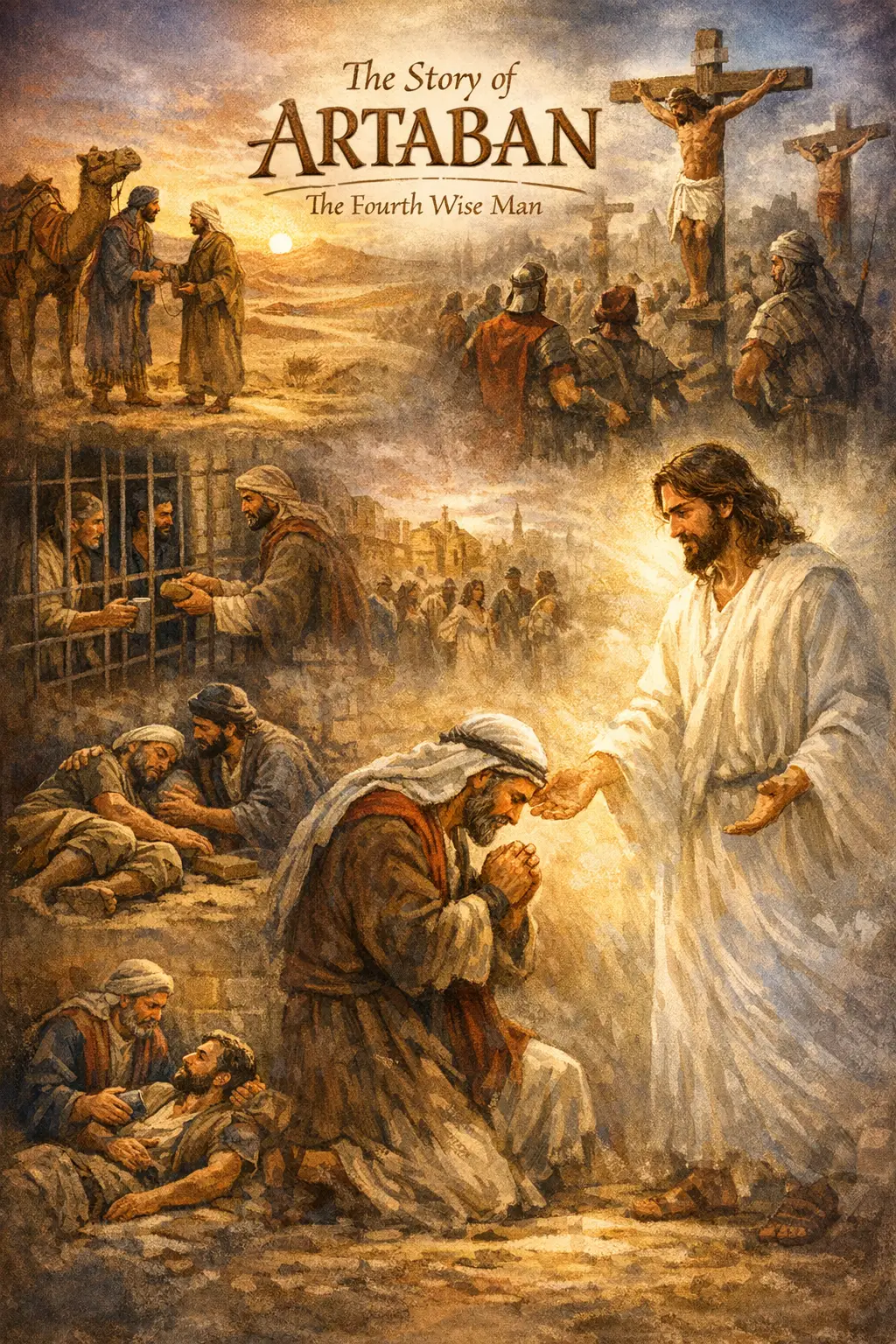
Thirty years later, Artaban arrived in Jerusalem and heard of a man performing miracles. He tried to see him but could not—crowds moved too quickly. As Artaban was leaving the city, he saw a crowd following a man carrying a heavy cross. He approached and whispered to himself:
Artaban:
I have found the Messiah. But what has happened? How can they crucify a man who has done nothing but good?
As he tried to draw closer, a soldier pushed him aside.
Soldier:
Get out of here unless you want to carry the cross yourself.
Artaban:
I would gladly do so without hesitation.
The soldier shoved him away. Artaban followed Jesus to the hill where he was crucified. With sorrow, he witnessed the Messiah’s final moments. After Jesus spoke his last words, he bowed his head and died.
Three days later, as Artaban was leaving Jerusalem, something extraordinary happened. With disbelief, he spoke:
Artaban:
What I see—it cannot be true. Are you the one I believe you are?
Jesus:
Yes, Artaban. I am who you believe me to be.
Artaban fell to his knees and bowed his head.
Artaban:
Forgive me. I wished to worship you at your birth, but I could not. I wanted to give you my gift, but I failed. I am not worthy to stand before you.
Jesus:
No, Artaban. You did not fail me. You met me many times along your journey.
Artaban:
I do not understand.
Jesus:
Whenever you helped the needy, you helped me. You fed me when I was hungry, gave me a drink when I was thirsty, and visited me when I was in prison. Every act of kindness you gave to my brothers and sisters was a gift to me—one that can never be replaced. Your reward is to be with me in paradise. Until then, could you continue to help me whenever you see me?
Discover more from Stories, Flowers and Books
Subscribe to get the latest posts sent to your email.
No responses yet